Learning to Set Healthy Boundaries in Relationships: Codependency Recovery Tips
Learn to set healthy boundaries and recover from codependency by recognizing and respecting your limits, crucial for fostering authentic relationships.


I was so confused. I thought because I spoke about what upset me, I was exerting boundaries. I was wrong!
Many of us might assume that because we are open about how we feel, and because we might complain, somehow that equates to a boundary.
It doesn't.
A boundary defines a line that you prefer others do not cross. It also allows you to better understand your own limits, which in turn, gives you the opportunity to reveal your true self to others.
Complaining to others about them crossing our boundaries is not the same as setting boundaries or honoring them once they are violated.
To be authentic, you must know yourself and to know yourself, requires you to be able to identify personal boundaries. Identifying a personal boundary requires a certain level of harmony between what you think and what you feel.
Codependency can be viewed as a survival skill.
Fawning, people-pleasing, care-taking, and reactivity serve to assist a codependent avoid overwhelming shame and unworthiness.
Where there is codependency, there is a need to find value in doing for others while avoiding the needs of the authentic self. In doing for others, there is the hope of feeling seen and worthy, while avoiding appropriately dealing with the emotions and experiences responsible for the codependent behaviors.
Codependency then provides a hiding place for the true self we may fear has not yet gained the right to be actualized.
The dismal reality is that until a codependent becomes awakened from their slumber, the brain continues to wire itself for survival. In a survival state, the body is denied what is necessary to fully thrive and the authentic self has declined the right to become actualized.
The ability to set a boundary relies on a certain level of integration within the mind, body, and inner self.
When we think we need to set a boundary, this thought has come from the inner self. The who that is doing the thinking is the individualized self that feels that a boundary is necessary.
- For the individualized self to recognize, appreciate, value, and honor what is felt, demands an open channel that is unscathed by shame, guilt, self-doubt, self-loathing, and unworthiness.
- The impulse to set a boundary may have derived from the emotional brain.
- The human brain has default settings that automatically alert us to the possibility of a threat.
- The fight or flight system responds the same way to physical as well as emotional threats.
- If and when the autonomic nervous system is activated and our bodies are alerted to a possible psychological threat, as it is in the case of being gaslighted, for us to assert a necessary boundary with a potential emotional predator would require one to be able to acknowledge, process, trust, and honor the sense of alarm.
Codependent beliefs and behaviors act to tolerate, deny, suppress, discount, and distrust gut instincts!
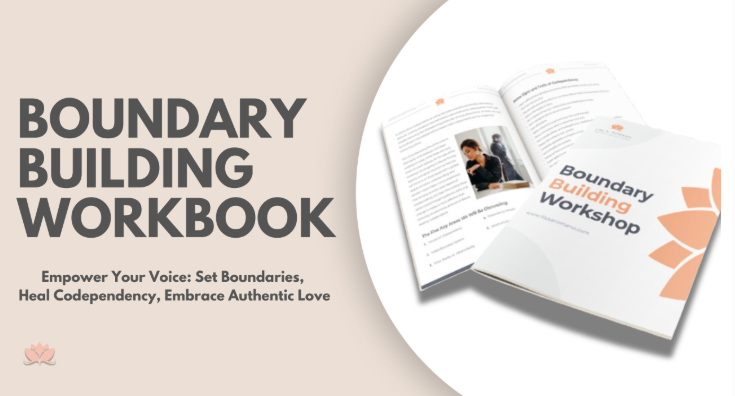
If you are ready to build better boundaries, this boundary-building workbook and bonus audio can help you clear the mental clutter that gets in the way of you honoring your authentic self.
It is not our fault when we don't know we have the right to set boundaries, ask for help, or expect others to understand why we need boundaries to feel safe and cared for.
On the road to recovery, we learn to explore whether our boundaries are too rigid, too loose, or need adjusting.
May you know that you are more than enough and that it is totally normal to feel challenged and to struggle to find balance when it comes to boundaries.
Your sister, on the path to emotional freedom and self mastery,
Lisa A. Romano